
Intro
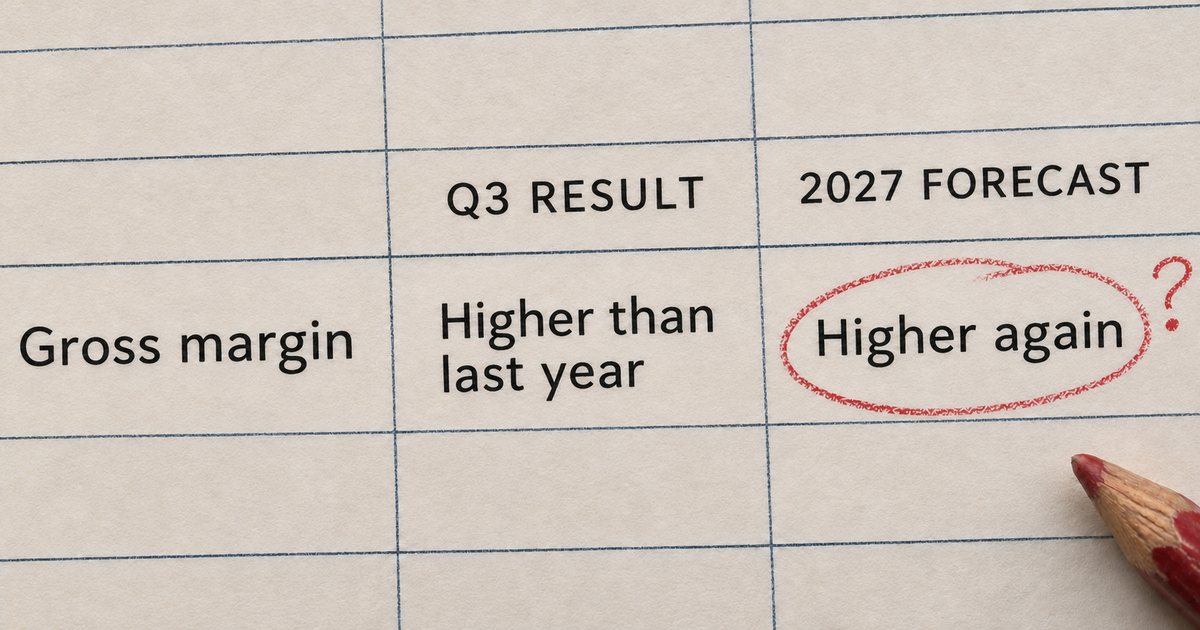
“Can we do that again?” is a request for information right up until somebody types the answer into next year’s budget.
On November 18, Target reported that its third-quarter gross margin had risen 2.3 percentage points. Tariff refunds accounted for 1.1 points, nearly half the gain. The rest takes more explaining. Target’s supply-chain facilities became more productive, and this year’s results benefited from a comparison with last year’s unusually heavy markdowns. A warehouse can keep moving goods more efficiently. Last year’s clearance rack has already done its part.
Now put a permanent hire on the agenda. If lower fulfillment costs will cover the salary year after year, finance has a case to examine. If the case works only when the refund comes back, somebody should mention that before the offer goes out. The candidate is likely to expect the salary to recur.
Executive summary
A budget makes a claim about cause. Put a gain into next year’s plan and you are saying someone can sustain it, management can count on the conditions that produced it, or a new initiative will replace it. Those are three different bets. They deserve three different explanations.
Four businesses show how easily a number can lose its meaning on the way to the budget meeting. Target received a refund. Walmart’s biggest shopping days moved between quarters in one market. At Anthropic, a promise to early investors grew more expensive as the company became more valuable. And when a shipper received a tariff refund, the person with a claim on the money could be at home opening a package.
For a leadership team setting 2027 targets, the test is simple enough to fit on the budget itself. Beside every material gain, write the amount the team can sustain, what has to happen to earn anything more, and who would know first if the assumption failed.
Core areas to watch
- 1The refund is the easy part to identifyTarget
- 2A sales event has moved. Has demand?Walmart
- 3What did the loss actually cost?AP via ABC News
- 4Whose cash is in the bank?AP via WRAL
The refund is the easy part to identify
FocusTarget · Third-quarter earnings · November 18, 2026
Summary Target’s gross margin rose from 28.2% to 30.5%. Removing the tariff refund leaves roughly 1.2 percentage points of improvement. That remainder deserves as much scrutiny as the refund.
Target cited last year’s elevated markdowns and tariff rates, growing non-merchandise sales, and productivity gains at supply-chain facilities. Fuel and freight costs worked against it. The company identified those forces without assigning each one a share of the remaining 1.2 points.
The tempting shortcut is to call the whole remainder operational improvement. Try that logic on clearance sales. If last year a buyer ordered too many coats and this year ordered sensibly, avoiding a second clearance is worth money. Getting the same lift again would require a fresh purchasing error to improve upon. Few boards would approve that strategy in writing.
Key takeaways
- Give each material change an explanation that an operating owner can verify.
- Leave the unexplained portion visible. Allocating it to a team makes the slide tidier and the target worse.
If last year’s clearance sale gets credit for this year’s margin, it deserves to attend the performance review.
A sales event has moved. Has demand?
FocusWalmart · Third-quarter results · November 19, 2026
Summary Walmart said the timing of Flipkart’s Big Billion Days sale reduced third-quarter net sales growth in its international segment by about five percentage points. It expected a corresponding benefit in the fourth quarter.
A manager looking at one quarter might cut inventory for lack of demand. Next quarter, the same manager might pay expedited freight to meet the apparent rebound. Two expensive decisions, one perfectly serviceable calendar.
Key takeaways
- Compare the same event across years before changing staffing, marketing, or inventory.
- Read the two quarters together. Test whether unit demand or customer behavior moved after the dates are aligned.
A promotion can miss the quarter and still turn up for work the following Tuesday.
What did the loss actually cost?
FocusAssociated Press via ABC News · What investors should know about Anthropic’s unusual IPO · November 18, 2026
Summary When the maker of Claude prepared to go public, its books showed a puzzling result. The more valuable the company became, the more expensive an old promise became. That promise accounted for much of the loss readers saw in the headlines.
Some early backers had lent Anthropic money they could later turn into shares. As those shares became more valuable, so did the backers’ right to receive them. Anthropic had to record that change as a loss. The people who pay its electricity bills could have spent all afternoon looking for a matching invoice.
The business still spent more than it earned from running Claude. That gap matters to anyone setting a price or approving more computing capacity. The change in what investors were owed matters to the owners. Put both on the agenda and ask which decision each should change. Cutting the computing budget would do remarkably little to rewrite a promise made years ago.
Key takeaways
- Ask what actually happened before asking a team to fix the loss.
- Use the same rule in a good quarter. If a change in an investment’s value sits outside the operating target when it hurts, keep it outside when it helps.
Before asking operations to cut a cost, ask who sent the bill.
Whose cash is in the bank?
FocusAssociated Press via WRAL · A surprise credit after an overseas purchase · August 13, 2026
Summary An overseas order arrives. The shopper pays the duty the carrier advanced at customs, opens the package, and gets on with the day. Months later, a credit turns up. Mae Anderson’s reporting for the Associated Press follows that payment all the way back to the person who paid it.
For some shipments, customs returned the duty to the carrier that had paid it on the shopper’s behalf. FedEx began sending those refunds back to customers and gave them a way to check their shipment by tracking number. That tracking number answers a question the bank statement cannot: whose order put the money here in the first place?
Now give the same problem to a company that collects deposits for events. The bank balance looks particularly healthy on Friday. On Saturday, several hundred people expect dinner. Before using that money to open a second venue, someone should price the first evening’s groceries.
Key takeaways
- For money collected on someone else’s behalf, trace one receipt back to the person who paid it.
- Before funding a new project, show what is still owed to customers, in refunds or in work you have promised to do.
The refund had reached its first stop. The customer had a different delivery address.
The $20,000 a month decision
Imagine a distribution business that finished the quarter $180,000 under budget. A second warehouse bay is available for $20,000 a month on a one-year lease. The quarterly review is suddenly a $240,000 decision, and the landlord would like an answer by Friday.
Purchasing traces $90,000 to a one-time supplier rebate. Operations accounts for another $45,000: a scheduled overhaul moved into January. The remaining $45,000 came from a lower contracted freight rate at the quarter’s shipment volume. The rebate can fund a one-time purchase. January already has plans for the maintenance money. Only the freight saving has a basis for recurring.
Even if shipment volume and the new rate hold for four quarters, that saving supports $180,000 a year, or $15,000 a month. The bay costs $5,000 a month more. Ask sales to identify enough additional business to cover the gap at its contribution margin, or ask the landlord for terms that let demand catch up. Copying $180,000 into four quarterly columns would have approved the lease before either conversation took place.
Case study spotlight
Case study spotlight
Jet2 filled more seats. Then it took 240,000 off sale.
FocusReuters · Jet2 joins rivals in cutting winter capacity as fuel costs rise · November 18, 2026
RelatedJet2 · Interim results for the six months ended September 30, 2026
From the departure gate, Jet2’s summer looked like a persuasive argument for more flights. It carried 15.4 million passengers in the six months through September, up 9%. Its planes were fuller, too. If the capital committee had stopped at passenger growth, the person asking for another aircraft would have had a remarkably short presentation.
The ticket desk had the missing evidence. Jet2 discounted flight-only fares to fill seats. Average flight-only ticket yield per passenger per flight, excluding taxes, fell from £121.88 to £104.82. Package holiday prices held up better. A full cabin told management how many people would travel at the price offered. It left open how many would pay the fare needed to justify another flight.
What a fuller cabin concealed
| Measure | 2025 | 2026 | Change |
|---|---|---|---|
| Seats filled | 88.2% | 89.7% | +1.5 points |
| Flight-only ticket yield1 | £121.88 | £104.82 | −14% |
With bookings still to come and fuel prices uncertain, Jet2 reduced its planned winter schedule by 240,000 seats from early September. The revised schedule still offered 3.8% more seats than the previous winter. Management had trimmed the expansion while preserving room to grow. The distinction matters to anyone approving the next facility, shift, or territory.
Before committing to new capacity, look at the last customers you added. What price brought them in? What did it cost to serve them? Then price the next block of capacity against the demand that remains. An average fare across all existing passengers gives the next aircraft rather generous credit for people who are already on board.
Boardroom implications
Take one proposed commitment into the meeting. Ask the people who own the forecast to bring the records behind these five answers.
- 1Cause
- 2Timing
- 3Definition
- 4Ownership
- 5Commitment
- Cause. What changed in the work? Ask the operating owner to show the unit cost before and after the change, at comparable volume and service quality.
- Timing. What moved between periods? Ask the commercial lead to line up both event dates. Have operations identify any cost that still comes due.
- Definition. Would the result survive reversing the sign? Ask finance to show how the same reporting rule treats an equivalent gain and loss.
- Ownership. Whose money has arrived? Ask treasury to reconcile the bank receipt to the beneficiary, outstanding obligations, and amount available to spend.
- Commitment. What are we about to sign, and for how long? Ask the sponsor what recurring income covers the cost and what evidence would change the decision.
The wrap-up
Go back to the candidate waiting for an offer. If freight savings will cover the salary and the volume is there to sustain them, make the hire. If the funding runs out when the rebate does, there may still be a good reason to hire. Someone now has to make that case on its merits. That is what the budget meeting was for.
A good quarter can get a proposal onto the agenda. It still takes twelve months of payroll to keep the promise.
Put one budget assumption under review
Choose one commitment before the 2027 plan is signed. Put the cost for its full term next to the recurring gain that will fund it. Give the gap a dollar value and a decision owner while the company can still change the terms.
Talk with Data Products about the number behind your next operating decision.
